In the Esthetic Zone: "Survival" is Not "Success"
In
the world of implant dentistry, we have a problem with definitions.
Many of us consider Implant Osseointegration the "finish line."
The implant is stable? Torque over 35 Ncm? The X-ray looks perfect?
Then congrats, the case is a success!
But the reality we face in the Anterior Esthetic Zone is completely different.
The patient doesn't look at the X-ray, the patient looks in the mirror.
If the implant is rock-solid in the bone, but there is mid-facial recession, or metal show (graying effect), or a conspicuous black triangle between the teeth…
this case — by modern implantology standards — is a Clinical Failure.
True success here is not just Mechanical Integration,
true success is Biological Harmony.
Therefore, before we pick up the handpiece, we must review the "Soft Tissue Triad"
that determines the fate of the case, and ignoring it leads to Prosthetic problems without solutions:

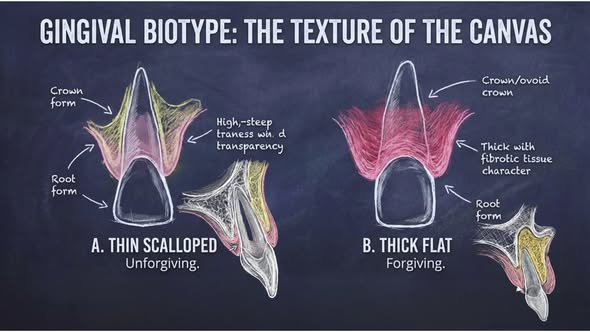
Gingival Phenotype (The Canvas Matters)
We used to call it Biotype; now the more accurate term is Phenotype.
Managing thin-scalloped tissue with the same protocol as thick-flat tissue is a recipe for disaster.
* The Risk: thin tissue — any surgical trauma, even minor, translates immediately into recession.
* The Graying Effect: the biggest nightmare, when the color of the titanium abutment shines through the thin gingiva producing a blue/gray shadow.
* The Solution: in these cases, Soft Tissue Thickening (surgical grafting) or using zirconia abutments is not a luxury — it is an absolute necessity (prerequisite).

The 2 mm Safety Zone (Bone Sets the Tone)
We all chase bone for primary stability.
But to preserve the soft tissue profile long-term, the literature (Misch et al.) sets a strict rule:
there must be at least 2 mm of labial bone in front of the implant.
* Why? Because after extraction and implant placement, natural bone resorption occurs.
If you start with 1 mm or less, that bone will resorb completely, and the soft tissue has no support so it will collapse.
* Clinical implication: palatal positioning of the implant with gap filling is the solution to preserve that critical 2 mm.

Biologic Width & Tarnow’s Rule
The body needs to form a seal to protect the bone (supracrestal tissue attachment).
If the restoration margin violates that distance, the body will resorb bone to recreate a new protective distance.
Regarding the interproximal papilla, the ruler does not lie:
* Distance from Contact Point to Crest of Bone ≤ 5 mm → papilla fill is almost guaranteed (100%).
* Distance 6 mm → probability drops to 56%.
* Distance 7 mm → probability only 27%.
It is essential to know these numbers to manage patient expectations
and not promise what biology tells you is impossible.

The Bottom Line:
In the Esthetic Zone: Biology drives Esthetics.
A successful implant is the one that disappears within the tissues as if it were a natural tooth.
Respecting Biologic Width, Tissue Phenotype, and the 2 mm Rule
is what transforms a "implant in bone" into "a complete smile."

References:
Serichetaphongse P, Beumer J, Faulkner RF, Wadhwani C, Khamis MM.
Restoration of Single-Tooth Defects in the Esthetic Zone
(Chapter 13 from the provided text).
Written by |Dr. Hossam Mansour